Jun 16, 2026
Stephen DeAngelis
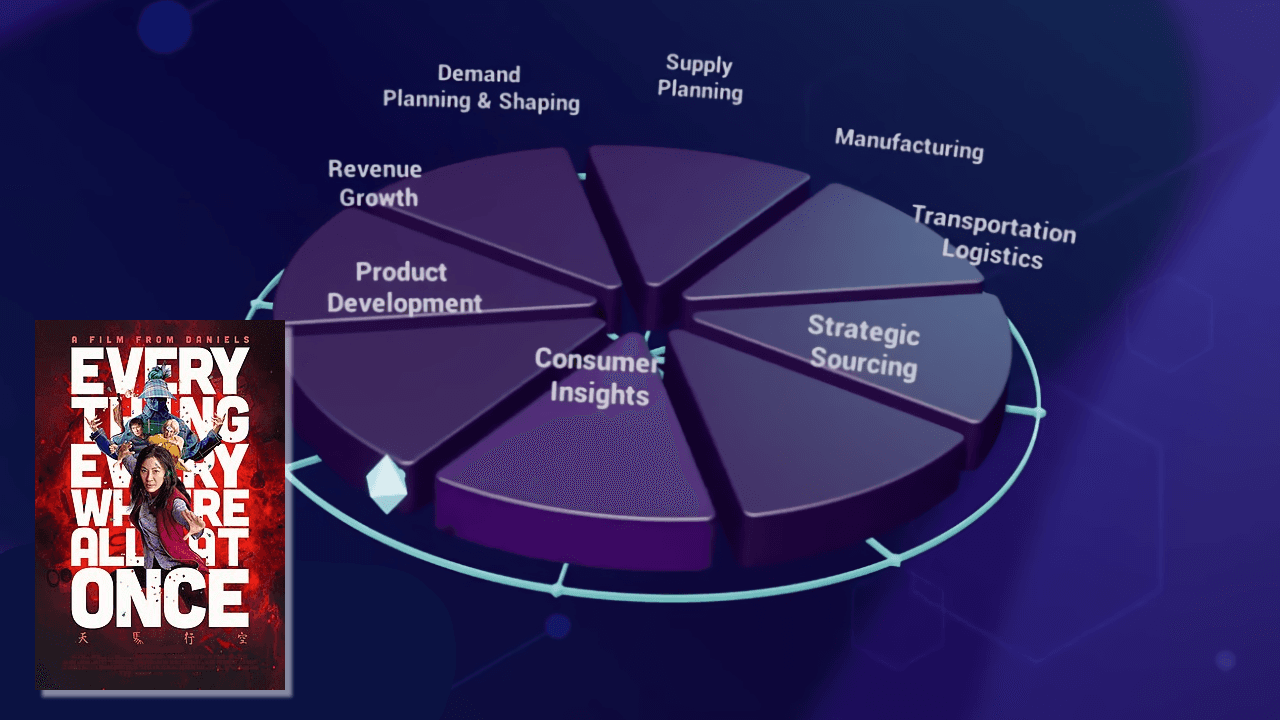
In the 2022 movie “Everything Everywhere All at Once,” the lead character, Evelyn Quan Wang, finds herself overwhelmed by the expectations placed upon her. She only finds relief by jumping into parallel universes in which she made different life choices and flourished. Marketing teams often find themselves overwhelmed and wish they had the same “verse-jumping technology” Evelyn possessed. Unfortunately, that technology does not exist.
There is another technology, however, that is changing marketing and providing relief for professionals under stress. It’s the same technology that is finding a place in almost every industry — artificial intelligence (AI). Phillip Andersen, Global Sales Practice Leader at Boston Consulting Group (BCG), with the help of BCG’s AI agent StoryBuilder, writes, “Imagine this: It’s 2035 and sales reps are no longer bottlenecked by bandwidth. Every potential customer, from global enterprise to niche startup, is within reach. AI agents handle the grunt work, scale support, and even build trust. Human sellers orchestrate it all, not alone — but with a team of digital workers by their side. This isn’t sales fiction. It’s the future of revenue, powered by agentic AI. And it could start sooner than you think.”[1] What he is describing is everywhere all at once marketing.
Everywhere All at Once Marketing
According to journalist Jason Hiner, “AI is moving beyond content generation to reshape media workflows end-to-end, from audience measurement to agents that automate entire processes.”[2] Sami McCabe, Chief Marketing Officer at Enterra Solutions®, notes, “Autonomous AI agents are like having a local guide who adapts to traffic, weather, construction, and your preferences — all while you focus on the destination. They don't just execute; they analyze situations, formulate strategies, and adapt in real-time with minimal human intervention. I've seen autonomous intelligence transform how marketing works.”
McCabe explains that Enterra’s Autonomous Decision Science™ platform goes beyond typical “black box” AI by combining human-like reasoning with advanced mathematical optimization. The result is “glass-box” machine learning that not only predicts outcomes with documented 90% accuracy but also explains exactly why those predictions make sense. McCabe believes every CMO should ask four critical questions about their company’s marketing system. Those questions are:
• Can the system make decisions autonomously, or does it just provide recommendations that require human implementation? If you still need a team to analyze outputs and manually execute changes, you're not getting autonomy.
• Does it integrate data from multiple sources in real-time, or are you still working with data silos and batch updates? Accurate autonomous intelligence requires unified, real-time data streams. Those streams should include data such as: consumer insights, strategic sourcing, transportation logistics, manufacturing, supply planning, demand planning & shaping, revenue growth, and product development.
• Can it explain its reasoning, or are you trusting a “black box” algorithm? In regulated industries and complex B2B sales cycles, explainable AI isn't optional — it's essential for stakeholder confidence.
• Does it adapt to changing conditions, or does it require reprogramming when market dynamics shift? If your “AI” needs constant human intervention during market volatility, it's sophisticated automation, not intelligence.
McCabe concludes, “The future of marketing isn't just automated — it's autonomous.”
Measuring Marketing Success
BCG partner, Janet Balis, writes, “The real value of AI emerges when the technology operates throughout the enterprise. And because CMOs function at the intersection of customer understanding, brand storytelling, and digital infrastructure, they are uniquely suited to lead integration — if they have the mandate to do so.”[3] As McCabe noted, data siloes can hinder everywhere all at once marketing. Balis agrees. She explains, “CMOs can evolve from tactical marketers to strategic growth architects by using AI’s power to break down organizational silos and connect marketing data with that of other business functions, such as supply chain, finance, and R&D. This interconnectedness gives CMOs a unified view of the enterprise, enabling them to link marketing actions directly to business outcomes.”
Measuring business outcomes has not been easy. According to McCabe, “78% of organizations utilize AI for at least one business function, yet 68% of marketers agree that evaluating the effectiveness of their digital media spend has become more difficult over the past five years. The problem isn't a lack of technology — it's that we've been deploying the wrong kind of intelligence. CMOs need autonomous intelligence, not just another AI bot.” He adds, “The real divide isn't between companies with AI vs. without AI. It's between companies that operationalize intelligence and companies that collect digital dust on expensive dashboards.” The Enterra System of Intelligence™ provides the kind of intelligence CMO’s require. The System of Intelligence delivers specialized applications designed to transform your entire marketing function, automating decision-making and delivery while driving measurable revenue growth and operational efficiency.
Concluding Thoughts
According to McCabe, “Most platforms are still asking: ‘What can we automate?’” He believes the better question is: “What decisions should we be making differently?” He explains, “That's where autonomous decision intelligence separates from basic agent deployment. You need systems that don't just react to prompts — they need to predict, prescribe, and execute in closed loops without waiting for humans to ask the right questions.” He believes that, even though marketing is having an “AI moment,” most CMOs are completely missing the point. He explains, “Most agencies are building tools to create content faster or measure campaigns better. That's not where the real opportunity is. The fundamental shift isn't about generating press releases with ChatGPT or analyzing sentiment with machine learning. It's about moving from ‘what happened’ to ‘what's going to happen’ to ‘what should we do about it.’ Real AI advantage comes from systems that can predict market responses before you launch a campaign. That can simulate competitive scenarios and prescribe optimal actions. That can automatically adjust strategy based on real-time signals.”
BCG analysts conclude, “There is little disagreement that AI will reshape marketing, but thinking too narrowly about the technology can limit its value. Marketing leaders who focus on isolated tools or pure efficiency gains are missing the bigger picture. The real opportunity lies in AI's ability to help CMOs reinvent their entire operating model in marketing to generate more profitable growth and enterprise value.”[4] That’s what everywhere all at once marketing is all about.
Footnotes
[1] Phillip Andersen, “Imagine This... AI Agents and the ‘Everywhere All at Once’ Sales Team,” Boston Consulting Group, 25 September 2025.
[2] Jason Hiner, “Why AI search broke the marketing playbook,” The Deep View, 27 April 2026.
[3] Janet Balis, “Imagine This... How Will AI Revamp Marketing—and the Role of CMOs?” Boston Consulting Group, 12 November 2025.
[4] By Janet Balis, Vas Bakopoulos, and Lauren Wiener, “From Campaigns to Business Value: How AI Will Transform Marketing,” Boston Consulting Group, 7 November 2025.