Stephen DeAngelis
The world is facing an increasingly uncomfortable situation as sea levels rise and coastal populations grow. A United Nations study noted, “Because of the economic benefits that accrue from access to ocean navigation, coastal fisheries, tourism and recreation, human settlements are often more concentrated in the coastal zone than elsewhere. Presently about 40% of the world’s population lives within 100 kilometers of the coast.”[1] Another study found, “More than 50% of coastal countries have from 80 to 100% of their total population within 100 km of the coastline. [And] twenty-one of the 33 world's megacities are found on the coast.”[2] To cope with the need for more coastal land, countries have often turned to land reclamation.
A study published three years ago found, “78% (106/135) of major coastal cities have resorted to reclamation as a source of new ground, contributing a total 253,000 hectares of additional land to the Earth's surface in the 21st century, equivalent to an area the size of Luxembourg. Reclamation is especially prominent in East Asia, the Middle East, and Southeast Asia, followed by Western Europe and West Africa. The most common land uses on reclaimed spaces are port extension (>70 cities), followed by residential/commercial (30 cities) and industrial (19 cities).”[3] The authors also observe, “The study suggests that 70% of recent reclamation has occurred in areas identified as potentially exposed to extreme sea level rise (SLR) by 2100 and this presents a significant challenge to sustainable development at the coast.”
Land uses not discussed include agriculture and power-generation — two areas essential to ensuring that the needs of future generations are met. So, what are countries going to do when the land runs out or is washed away? One solution is to float needed resources.
Power Generation on the Ocean
The viability of floating power plants was proven nearly a century ago when the USS Lexington (CV-2) provided the city of Tacoma with power during a 30-day power shortage in the winter of 1929. Wikipedia reports, “Power barges and power ships offer a number of advantages over other forms of power plant. ... Power barges and power ships are able to use any infrastructure available at the site on which they are required. … Today there are over 75 power barges deployed and operating around the world. The utilization rate of power barges is around 95% with only one or two power barges available in the global market at any one time.”
Marketing executive Akshay Dharmadhikari reports, “The global energy landscape is shifting, with nations racing to secure affordable, resilient, and low-carbon power solutions. Against this backdrop, floating power plants (FPPs) are emerging as a transformative force. With the floating power plants market projected to exceed USD 8.6 billion by 2034, these mobile energy hubs are positioned to bridge gaps in global electricity demand, particularly in regions with limited land availability or unstable grid networks.”[4]
The World Nuclear Association is also studying the feasibility of floating nuclear power plants. The Association notes, “Floating nuclear power plants (FNPPs) represent a transformative innovation in clean and reliable energy production, offering a versatile and sustainable solution to addressing climate change and increasing global power demand. FNPPs are designed to be mobile, scalable through shipyard assembly and flexible in terms of site selection and resilient against natural disasters, making them an attractive alternative to traditional land-based nuclear facilities, especially in remote areas where the construction of large nuclear facilities is not feasible.”[5] They admit, however, that a number of challenges and concerns must be met before FNPPs become a realistic solution.
Nevertheless, putting resources afloat is exactly what you do, writes scientist Neil deGrasse Tyson, “when land is too valuable to waste.” Tyson reports, “China is building massive solar panel farms on water instead of land. They're called floating solar farms, and the concept is simple. Mount solar panels on buoyant platforms and let them float on reservoirs, lakes, and artificial water bodies. Generate clean energy without touching a single acre of farmland. China now operates the two largest floating solar projects in the world.”[6]
Agriculture Afloat
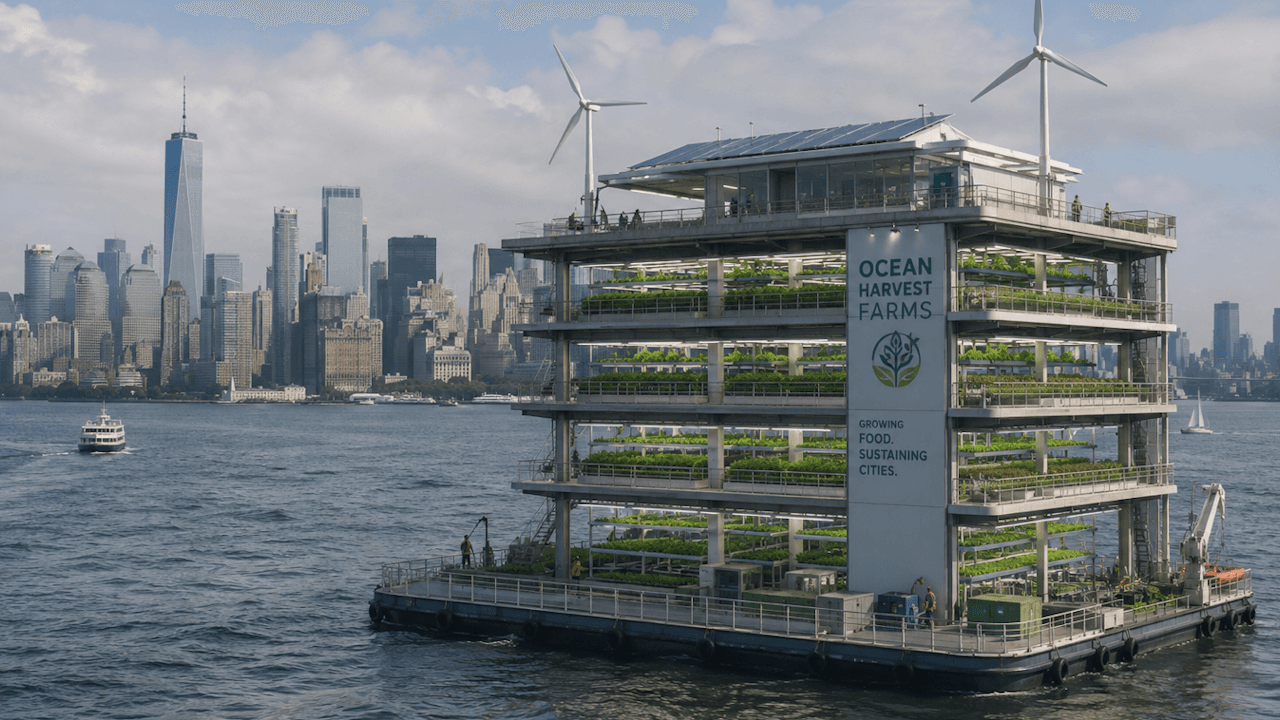
China lets no opportunity go to waste. Underneath some of its floating solar panel farms lie massive aquaculture farms raising fish, shrimp, and crabs. Floating agriculture is a concept gaining more traction every day. Over a decade ago, Don Willmott, an XPRIZE contributor, asked, “Are floating farms in our future?”[7] He wrote above futuristic three-story floating farms where food was grown above the ocean and seafood raised in the ocean. A year earlier, futurist farmer Jesse Hirsch wrote, “If you ponder humanity’s prospects for the next 50 years, things can look a little bleak. Climate change is shrinking our coastlines. Unsustainable farm practices are depleting our soil. Billions of new mouths will need to be fed. In a world of swelling populations and dwindling farmland, some predict we’re running out of places to go — and to grow food. What’s to be done? [For many futurists,] the answer is patently obvious. More than 70 percent of the Earth’s surface is water. Our future is on the ocean.”[8]
One of the challenges for a farm afloat on seawater is obtaining enough freshwater to grow crops. Several years ago, researchers from the University of South Wales claimed to have solved that problem. They “created an autonomous solar-powered system that evaporates seawater and converts it into freshwater, enabling crop cultivation without human intervention. … During a field experiment, the scientists grew three vegetable crops, broccoli, lettuce, and pak choi, on seawater surfaces without needing ongoing maintenance or additional freshwater irrigation.”[9]
Although afloat farming on a large scale remains aspirational, interesting afloat farms have been developed. The Netherlands, which has a long history of land reclamation, is also home to the world’s first afloat dairy farm. Created by Peter and Minke Van Wingerden, until recently the farm wat on water in the middle of Rotterdam. Cows on the farm were free to wander on and off the floating platform at their leisure. Whenever they needed milking, they simply walked onto platform and hooked themselves up to an automated milking machine. The dairy was completely automated. Fitted with cameras and sensors, the Van Windergerdens measuree everything — temperature, wind speed, relative humidity, if the cows were lying down, if they were standing up, if were eating, if they were inside or outside. On the level below the milking deck, the milk was pasteurized or made into butter. Below that cheese was produced under temperature-controlled conditions. The Van Windergerdens fed their cows on donated brewer’s grain from local breweries, stale bread from local bakeries, and grass clippings from the local soccer stadium. They desalinated water for the cows to drink and used cow dung to power the plant. Unfortunately, the fate of the farm is now up in the air.[10]
Concluding Thoughts
Power production and floating farms aren’t the only innovative ideas headed to sea. Screenwriter and producer Jesus Diaz reports, “Jiangnan Shipyard, a subsidiary of China State Shipbuilding Corp., has designed a massive offshore facility that functions simultaneously as a container terminal and a ship-recharging station. The floating island will be powered entirely by nuclear energy and renewable sources.”[10] He adds, “This is not the first time that China is trying to extend its tentacles with big floating structures. The country is already building strategic research platforms designed to extend its scientific and geopolitical power far outside its borders.” Despite rising sea levels, coastal locations will continue to attract people and dominate the global economy. It makes perfect sense for innovators to extend the shoreline seaward through the use of floating structures that cater to the needs of the people living ashore.
Footnotes
[1] Staff, “Percentage of Total Population Living in Coastal Areas,” United Nations, 15 June 2007.
[2] M.L. Martínez, A. Intralawan, G. Vázquez, O. Pérez-Maqueo, P. Sutton, R. Landgrave, “The coasts of our world: Ecological, economic and social importance,” Science Direct, 25 January 2007.
[3] Dhritiraj Sengupta, Young Rae Choi, Bo Tian, Sally Brown, Michael Meadows, Christopher R. Hackney, Abhishek Banerjee, Yingjie Li, Ruishan Chen, Yunxuan Zhou, “Mapping 21st Century Global Coastal Land Reclamation,” Earth’s Future, 9 February 2023.
[4] Akshay Dharmadhikari, “Floating Power Plants: Redefining the Future of Offshore Energy,” Research World, 8 September 2025.
[5] Staff, “Facilitating Global Deployment of Floating Nuclear Power Plants,” World Nuclear Association, 8 August 2025.
[6] Neil deGrasse Tyson, “China builds massive floating solar farms on water,” Facebook, 28 March 2026.
[7] Don Willmott, “Are Floating Farms in Our Future?” Smithsonian Magazine, 1 September 2015.
[8] Jesse Hirsch, “Floating Farms,” Modern Farmer,19 March 2014.
[9] Staff, “Floating sea farms: A vision to feed the world,” Open Access Government, 12 September 2023.
[10] Harry Holmes, “Red tape sinks world’s first floating dairy farm,” Food Navigator, 5 August 2026.
[11] Jesus Diaz, “China is designing a floating, nuclear-powered shipping port of the future,” Fast Company, 24 June 2026.