Sep 1, 2026
Stephen DeAngelis
Around the globe, various industries and governments celebrate Sustainable September. During the month conferences are held, clean-up projects are conducted, and companies are reminded of the benefits of creating sustainable supply chains. This year, with heat, wildfires, and drought adversely affecting much of the globe, highlighting the importance of sustainability efforts seems even more appropriate.
Although the current U.S. administration has downplayed sustainability, Jason Schenker, President of Prestige Economics and Chairman of the Futurist Institute, reports that sustainability in Europe and other international markets remains a priority. He explains, “While U.S. policies may have softened, the global sustainability landscape remains unchanged. In Europe, stringent sustainability and emissions mandates continue to set the standard for corporate responsibility. … For companies operating globally, meeting the sustainability expectations of European markets is not optional. Failing to comply with these standards risks losing access to key international customers and supply chain partnerships. Moreover, global companies are increasingly aligning their own sustainability metrics with European benchmarks to ensure consistency and transparency in their reporting.”[1]
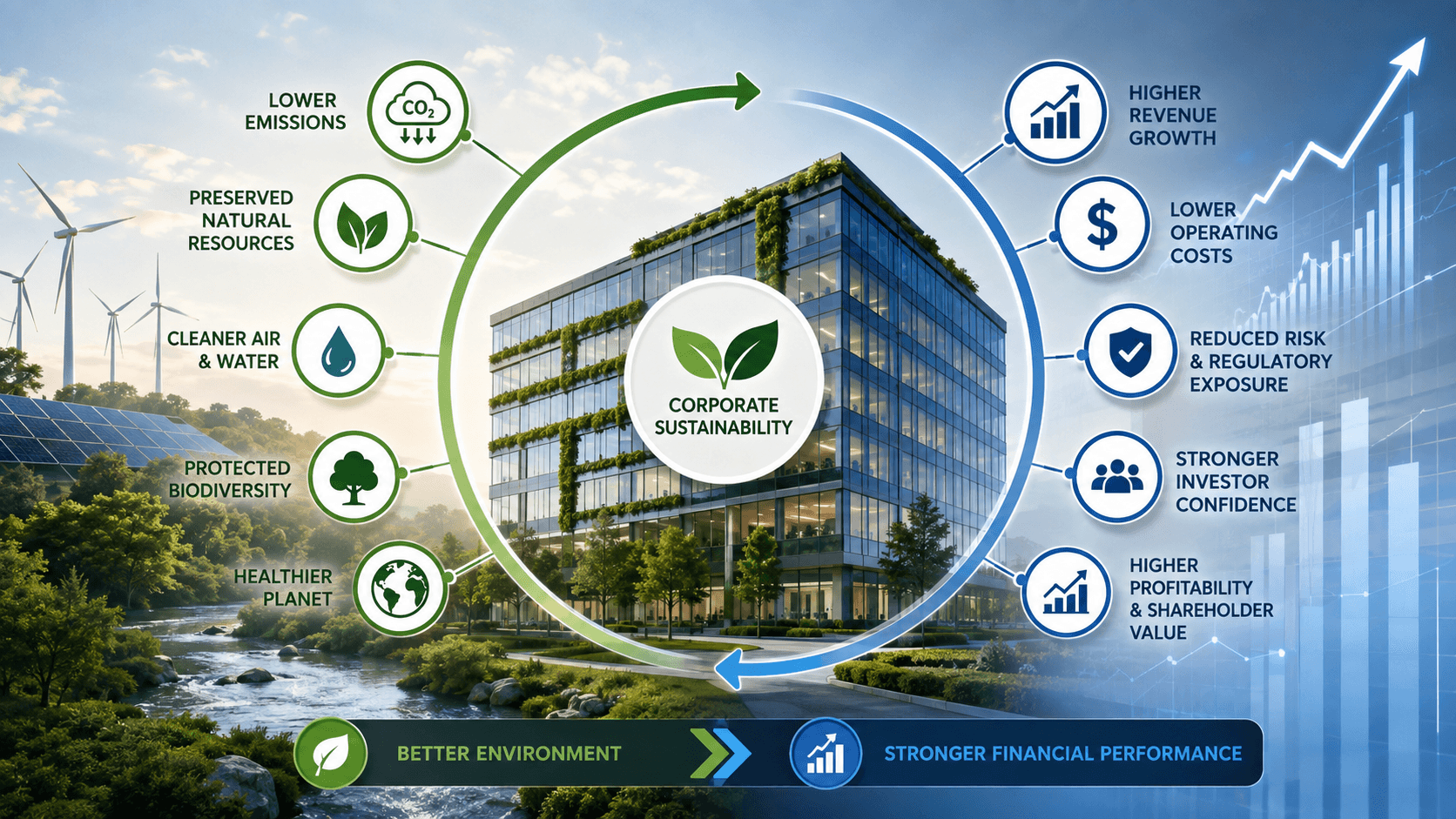
Why Sustainability is Good for Business
Climate change affects almost every global economic sector. And those impacts are mostly negative. Gunnar Trumbull, the Phillip Caldwell Professor of Business Administration at Harvard Business School, believes it is up to business leaders to address the climate crisis. He understands that doing so will neither be easy nor cheap. He explains, “Climate change is a big problem. It will require ingenuity and large allocations of capital to address.”[2] He observes that many of the resources that enterprises rely on are becoming scarce and will require careful management. However, the scarcest resource, according to Trumbull, might surprise you. He writes, “The most valuable and potentially scarcest resource through this transition is likely to be effective and thoughtful leadership. Sector by sector, we face the kind of transformation that will challenge the mettle and vision of our global managerial class.”
Robert Metzke, Global Head of Sustainability at Philips, believes that leaders who can provide effective and thoughtful leadership will not only help address sustainability issues but will improve their companies’ performance. He explains, “Sustainability is a shared responsibility that demands coordination, collaboration and bold action. Success isn’t about isolated efforts; it involves aligning strategies, working with partners and taking meaningful steps toward lasting change.”[3] The task may seem insurmountable. Metzke says it isn’t. He writes, “In a fast-changing climate and regulatory environment, perfection isn’t the goal — progress is.” He suggests five ways that promoting sustainability efforts are good for business. They are:
1) Sustainability offers a competitive advantage. Every company is looking for an edge over its competitors. According to Metzke, “Sustainability leaders capture market share, improve customer retention and build resilient operations.” Why? Companies that pursue the strongest sustainability efforts not only meet stringent international standards (hence, they can operate globally), they are better positioned to deal with disruptions than their competitors.
2) Digitalization, data, and transparency accelerate supply chain resilience. For years, business experts have predicted that digital enterprises will be better positioned to beat their competition and improve performance. Metzke asserts that digital businesses are also better positioned to address sustainability challenges. He writes, “Good intentions don’t cut emissions. Data does. Data-driven emissions tracking and real-time insights help companies find faster, smarter ways to reduce emissions, increase efficiency, and cut costs. Successful sustainability leaders are rapidly pivoting sustainability to a business enabler, rather than treating it as a compliance checkbox or reporting exercise.”
3) Collaboration and leadership support systemic change. Supply chain consultants consistently push for more collaboration. According to Metzke, collaboration is absolutely essential in dealing with sustainability issues. He explains, “Too often, companies focus on internal sustainability efforts while overlooking the broader value chain. The key to delivering systemic change lies in collaboration, with cross-industry partnerships, supplier engagement, and leadership that balances long-term sustainable value creation with short-term gains being crucial to succeed.”
4) Sustainability as a profit generator, not a company expense. Metzke should have led with this assertion. Every business wants to improve its profits. But, how do reconcile Trumbull’s claim that sustainability efforts will require “large allocations of capital” and Metzke’s assertion that they can be “profit generators”? According to Metzke, “Sustainability is often perceived — and misconceived — as an added expense, with traditional financial models overlooking hidden environmental costs, such as emissions and resource depletion. Additionally, as regulation evolves — in the EU in particular — businesses must adapt to pricing and investment strategies that reflect the true cost of environmental impact. Companies embedding sustainability into their core strategies are creating strategic advantages. They consistently reduce operational costs, attract investors, and increase resilience.”
5) Train and upskill workforces to drive a sustainable future. Like Trumbull, Metzke believes that leadership in this area is a scarcity that must be addressed. He explains, “Beyond innovation, differentiation and financial incentives, scaling sustainability across value chains can only succeed if people are equipped to lead it. Every function must build sustainability into its mindset and skillset.”
Metzke concludes, “This is the decade of delivery. Action is the only metric that counts. Supply chain transformation is already happening.” He then asks, “Are you ready to lead it?”
Why Rejecting Sustainability is Bad for Business
Flipping the coin, journalist Augustus Bambridge-Sutton argues that rejecting sustainability efforts is bad for business. He notes that “drought, heat, storms, and unpredictabilty” are affecting corporate bottom lines “by pushing costs up.”[4] He adds, “Many supply chains are bracing themselves for the potential impacts of climate catastrophe. Even large companies, which once believed they were immune from the volatility caused by disruptive weather events, are fearing they may, in fact, be vulnerable.”
Looking at the current political landscape, Bambridge-Sutton sees a darker picture than Schenker. He writes, “While sustainability has not vanished entirely, it is clear that interest in green policies, green corporate goals, and green lifestyles is ebbing. Skepticism is the name of the game.” This skepticism, he believes, is bad for business. He writes, “In the long run, these problems will be made worse, rather than better, by casting sustainability to the winds and embracing environmentally harmful practices with open arms.” More importantly, he adds, “Unsustainable practices can end up being a vicious cycle in some cases.” He points, for example, to deforestation and how that activity exacerbates climate change. Like Trumball, he recognizes that sustainability efforts require capital outlays. Nevertheless, he argues they are worth the cost. He explains, “Sustainability targets may harm competitiveness in the short-term, but all companies will be made vulnerable by the increased frequency of destructive weather events.” Like Metzke, he encourages companies to collaborate more. He notes, “Climate change doesn’t pick and choose. All businesses are affected by the weather, no matter how committed to sustainability they may be. … It’s only with collaboration, not instead of but alongside competition, that sustainability can truly thrive.”
The good news is that a 2025 study by MIT researchers concluded, “Corporations are actively seeking sustainability advances in their supply chains.”[5] Josué Velázquez Martínez, a former director of the MIT Sustainable Supply Chain Lab, stated, “What we found is strong evidence that sustainability still matters. There are many things that remain to be done to accomplish those goals, but there’s a strong willingness from companies in all parts of the world to do something about sustainability.”
Concluding Thoughts
I firmly believe that companies working to address sustainability challenges will be the most successful in the years ahead. At the same time, the discussion above highlights the fact that companies must be pragmatic about how they address sustainability issues. I agree with Mayank Sharma, Chief Product Officer at Intellitrans, who observes, “Sustainability will always be complex, but companies that succeed will treat it like logistics: a continuous process of measurement, learning, and improvement. Progress doesn’t require perfect data or unlimited resources — just consistent action and transparent reporting that build confidence.” Or as Metzke noted above, “In a fast-changing climate and regulatory environment, perfection isn’t the goal — progress is.” Sustainable September is a good time to recommit to sustainability efforts and begin collaborating with others to help address challenges created by climate change. We’ll all be better for it.
Footnotes
[1] Jason Schenker, “Sustainability in Transition: Navigating Shifting Standards in a New Political Landscape,” MHI Solutions, 6 March 2025.
[2] Gunnar Trumbull, “A Call for Business Leaders to Shape a Greener World,” Working Knowledge, 19 August, 2025.
[3] Robert Metzke, “Five reasons why sustainable value chains are good for business,” World Economic Forum, 15 September 2025.
[4] Augustus Bambridge-Sutton, “Rejecting sustainability is bad for business,” Food Navigator, 26 September 2026.
[5] Peter Dizikes, “Report: Sustainability in supply chains is still a firm-level priority,” MIT News, 6 October 2025.
[6] Mayank Sharma, “Why Sustainability Depends on Pragmatic Execution,” SupplyChainBrain, 26 November 2025.