Apr 28, 2026
Stephen DeAngelis
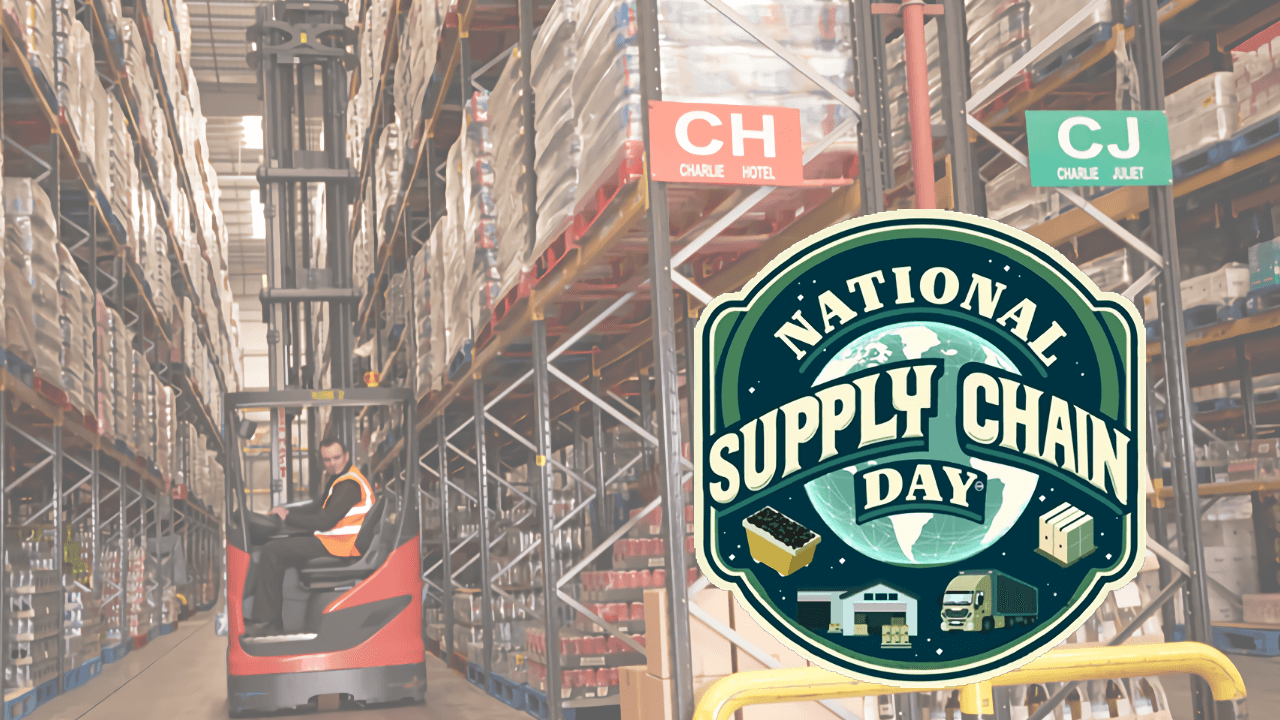
Supply chains have traditionally operated with little attention from the public. Consumers expect to find the products they use, at the locations they shop, when the products are needed. Only when disruptions occur do consumers realize how much their daily lives depend on the people and processes associated with supply chains. Every year, on 29 April, Supply Chain Now sponsors National Supply Chain Day®. According the Supply Chain Now staff, “[The day] is a celebration and a spotlight on the industry professionals of Supply Chain: the people that connect the world. From the intricate logistics that power your morning coffee to the complex networks ensuring critical medical supplies reach their destinations, supply chain professionals are the backbone of our connected world.”[1] This year supply chain professionals deserve special recognition for confronting the many challenges associated with global trade.
Celebrating the Supply Chain in a Chaotic World
A report published last year by GlobalData defined the term “supply chain” this way: “A supply chain comprises the activities and processes that organizations perform to manufacture and deliver goods and services to consumers. Supply chain disruption occurs when these processes are compromised.” According to many experts, disruptions are entering a new, unprecedented era. Journalist Stu Robarts asserts, “Global supply chains assembled and organized to optimize profit and speed for over two decades were flipped upside-down by the Covid-19 pandemic and are now a thing of the past.”[2]
Even before the conflict in Iran caused the latest massive disruptions to global supply chains, Kiva Allgood, Managing Director at the World Economic Forum, asserted that the world had entered an era of constant disruption. She said, “Volatility is no longer a temporary disruption; it is a structural condition leaders must plan for.”[3] Per Kristian Hong, a partner at Kearney, agrees with that assessment. He insists, “Supply chain disruption in 2026 will be constant and structural. Geopolitical fragmentation, shifting trade rules and labor shortages are all redefining how value is created and moved.”[4]
As I wrote in a LinkedIn comment, “The shocks are no longer independent. An energy spike feeds inflation expectations. Inflation constrains central bank flexibility. Tighter financial conditions compound the burden on companies already absorbing tariff-driven margin compression. The causality is circular and accelerating. … The problem isn't the shocks. It's the architecture.”[5]
Creating the Future Supply Chain
According to Allgood, “Competitive advantage now comes from foresight, optionality, and ecosystem coordination. Companies and countries that build these capabilities together will be best positioned to attract investment, secure supply, and sustain growth in an increasingly fragmented global economy.” How do you achieve that competitive advantage? As I observed in my LinkedIn comments, “What I observe across industries is not a failure of effort. It is a failure of learning architecture. Organizations are accelerating existing strategies rather than questioning their governing assumptions.”
Hong agrees. He insists, “For supply leaders, the priority is no longer forecasting disruption, but redesigning operating models to function under permanent uncertainty. That means moving away from efficiency-driven supply chains and towards adaptive networks that can be reconfigured with optionality as conditions change.” When you examine the action words used by Allgood and Hong (i.e., foresight, optionality, coordination, redesign, and adaptation), You understand why I stress the importance of learning architecture.
Enterra Solutions® has developed the Enterra System of Intelligence®. This System ushers in a new era of AI-enabled management science by merging cutting-edge analytical techniques with a business’ data and knowledge to Sense, Think, Act, and Learn® on enterprise data to meet the changing needs of the market. Enterra’s system uniquely learns the environmental reasons that recommendations are successful or not and persists that learning in its Ontologies and Generative AI knowledge bases to improve future insights and recommendations.
Enterra® has also created Enterra Business WarGaming™ that enables organizations to leverage their data to make strategic decisions by anticipating the moves of their competitors and taking direct action to beat the competition, mitigate risk, navigate uncertainty, and maximize market opportunity. Part of Enterra Business WarGaming is the Enterra Global Insights and Decision Superiority System™ (EGIDS™) — powered by Enterra’s Autonomous Decision Science™ platform — which can help business leaders rapidly explore a multitude of options and scenarios.
In a world characterized by constant disruption, creating supply chains that can mitigate those disruptions is something worth celebrating.
Concluding Thoughts
As I noted at the beginning of this article, supply chains generally operate with little attention from the public. However, David A. Mindell, a professor at the Massachusetts Institute of Technology, reminds us, “Every purchase we make ties us to a vast, hidden network of people, machines, and resources — whether we see it or not.”[6] Mindell cites his MIT colleague, supply chain guru Yossi Sheffi, who wrote, “Once one understands what is involved in just a single overseas shipment to a consumer’s home, the question is not why the item does not make it on time but rather astonishment and wonder that such a thing can be completed in the first place.” Surely, that is something to celebrate.
Mindell writes, “Consider any product in your home. Where was it made? (That should be written on the label somewhere.) Where were the parts made? Who put them all together? How did it get to your doorstep? Every object embodies answers to those questions, though it’s overwhelming to think about every one. Nonetheless, it’s a worthy exercise to do every once in a while for some objects, including your food.” He concludes, “The goals of the thousands of people who plan, manage, and operate [supply chains], is the opposite of disruption. Keep the goods flowing. Keep the power on. Keep the trains running. Keep everyone safe while doing it. Smoothness, reliability, and efficiency are the watchwords. Dynamism is inevitable, but disruption is the enemy.” The efforts of every supply chain worker deserves both recognition and thanks. National Supply Chain Day is a perfect time to thank them all.
Footnotes
[1] Staff, “A Celebration and Spotlight of the Industry That Connects the World,” Supply Chain Now.
[2] Stu Robarts, “The era of easy, frictionless supply chains is over – GlobalData,” Investment Monitor, 4 April 2025.
[3] David Priestman, “Supply Chains in Permanent State of Disruption,” Logistics Business, 20 January 2026.
[4] Ibid.
[5] Stephen DeAngelis, “The week the playbooks broke,” LinkedIn, 20 March 2026.
[6] David A. Mindell, “Supply Chains Are Us,” The MIT Press Reader, 24 February 2026.