
Stephen DeAngelis
It’s very rare in today’s polarized political environment to find a topic on which both sides agree. One such topic might be the imperative for countries and companies to adapt to climate change. In an op-ed piece co-written by Alex Flint, executive director of the Alliance for Market Solutions, and Kalee Kreider, a Principal with The Kreider Group, they explain why, despite their political differences, they agree on this subject.[1] Flint, a Republican, and Kreider, a Democrat, write, “We’ve often been on opposite sides of the same debate. But we now share an uncomfortable conclusion: Despite decades of dire projections about the climate, humanity has shown that it’s unwilling to impose the limits on economic activity that would be necessary to keep global warming below 1.5 degrees Celsius, or even below 2 degrees. As global energy demand continues to grow, fossil-fuel use remains dominant, and political commitments fall short of the necessary transformation. It isn’t that society can’t change but that it won’t. Around the world, people are giving priority to higher living standards, economic security and access to affordable energy above a stable climate.”
The New Reality
The implications of Flint’s and Kreider’s conclusion (i.e., it’s time to adapt to climate change) is both profound and troubling — but not surprising. For several years, I have argued that companies need adapt to climate change. Investors have also encouraged companies to embrace adaptation strategies. Last year, strategic analyst Thomas P.M. Barnett reported, “It has been long noted that investment in climate change-related projects overwhelmingly favors mitigation over adaptation — basically a 90/10 split. But more and more we’re hearing about investors and financial firms waking up to the benefits — and profits — associated more with adaptation.”[2] As the late naturalist Charles Darwin postulated, the species best able to adapt to changing circumstances is the species most likely to survive. The same holds true with companies.
Flint and Kreider report that mitigation efforts have had positive effects and they continue to support those efforts. They write, “Adaptation isn’t surrender — it’s survival. Many people will find the economic imperative to adapt and become resilient more compelling than the moral imperative to mitigate.” Why? They explain, “An agenda focused on adapting can unite rather than divide. Unlike mitigation, which often provokes partisan battles over energy, regulation and ideology, adaptation is rooted in practicality and shared human interests. Preparing for a changing climate can and should be bipartisan — much like national defense, which commands broad support because it protects lives, property and national stability. In the same way, a coherent adaptation strategy is an act of collective self-defense against a threat we can neither ignore nor entirely prevent.”
The Way Ahead
There should be little doubt in any business leader’s mind that climate change adaptation is an imperative. To bring attention to the criticality of climate change adaptation, a Global Commission on Adaptation was formed in October 2018. One of its mandates was “to accelerate adaptation by elevating the political visibility of adaptation and focusing on concrete solutions.”[3] The Commission’s work ended in 2020, but it’s mandate is now being carried on by the Global Center on Adaptation. During the years the Commission was active, it determined that a significant amount of money could be saved by early investments in adaptation. They also believed that such investments would result in significant benefits. The Commission concluded “that $1.8 trillion in investment by 2030 … would yield $7.1 trillion in benefits.”[4]
Despite the evidence supporting adaptation investments, analysts from the Boston Consulting Group (BCG) report, “While some organizations have begun to retool, many others still underestimate the impact of the shift.”[5] They argue that operational adaptation strategies must be complemented by personnel adaptation strategies. They explain, “Our analysis shows that 25% to 50% of roles across sectors will need to evolve to meet sustainability priorities. Most are existing positions — not new ‘green’ jobs — and many fall within core functions.”
Shemara Wikramanayake, CEO of the Macquarie Group and an original member of the Global Commission on Adaptation, insists, “Investment is required in adaptation, given that climate change is on us. What we’re keen to do is now use that awareness-building to move on to the next step, which is developing solutions to address the challenges.”[6]
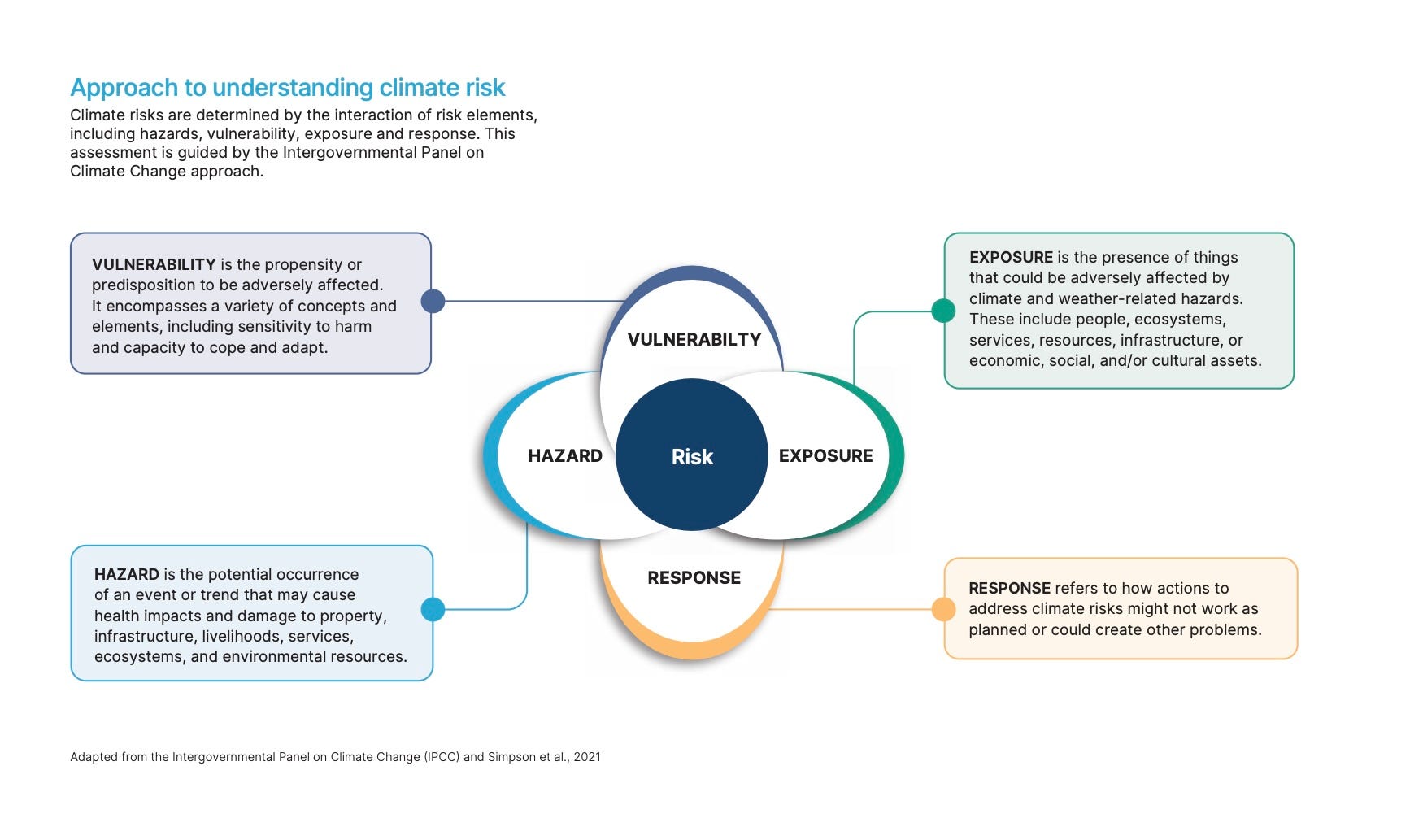
Before countries and companies can develop a strategic plan for adapting to climate change, they must assess their current situation. To help with such assessments, the Australian Climate Service developed a model they call the “cycle for adapting to a changing climate.”[7] The first stage of the cycle is to “understand and assess” the current situation. The second stage of the cycle is to “prioritize and plan” to meet the shortfalls identified during the first stage. The third stage is to “adapt and respond” to new realities. The final stage of the cycle is to “monitor change.” Since this is a “cycle,” it must be constantly engaged. The following graphic shows what should be included during the “understand and assess” stage.
Katherine Klosowski, a former Vice President FM Global, indicated that another way of looking at climate change adaptation could be summed up in three words: understand, plan and fortify. She explained, “Executives need to understand what the impact of climate risk is to their organization. Are they in a flood zone? Are they in an earthquake zone? Or are they susceptible to hail damage? Once they understand what risks are present at each of their locations, then they can start planning what they're going to do about that. And here's where they really need to take a strategic look at their plan. Identify the locations that are really driving their revenue stream, and protect those first. And that leads into the third item, which is to fortify. Identify the strategic buildings or processes and fortify those to prevent damage from the event. When I think about fortifying, it's the physical structure, so the buildings, as well as their supply chain.”[8]
Concluding Thoughts
Flint and Kreider conclude, “For too long, the debate over climate change has been framed as a battle between denial and ambition, between doing nothing and doing everything. It’s time to embrace a third way: clear-eyed realism. We must acknowledge what humanity is and isn’t willing to sacrifice and plan accordingly.” BCG analysts agree. They conclude, “At first glance, the climate transition may feel like it’s stalling. But operational shifts, from climate risk exposure to supply chain and resource demands, are unfolding regardless of policy direction. Instead of waiting things out in hopes of saving resources or channeling them elsewhere, the smart money will start building the sustainability talent they need now — when doing so is less pressured, less costly, and more likely to give leaders competitive advantage.” The bottom line, according to Bloomberg reporters, is this: “While humans must pay to end the burning of fossil fuels, they must also pay to change how they live, invest and build in a climate-changed world.”[9] The sooner you invest in climate change adaptation, the less it will cost and the greater the benefits will be in the long run.
Footnotes
[1] Alex Flint and Kalee Kreider, “We Can’t Stop Climate Change, So We Need to Prepare for It,” The Wall Street Journal, 19 October 2025.
[2] Thomas P.M. Barnett, “Waking up to climate adaptation,” Thomas P.M. Barnett’s Global Throughlines, 19 March 2024.
[3] Staff, “The Global Commission on Adaptation,” Global Center on Adaptation.
[4] Bloomberg, “The Massive Cost of Not Adapting to Climate Change,” SupplyChainBrain, 10 September 2019.
[5] Alice Bolton, Evelien Dupont, Stephanie Del Carpio, and Jens Baier, “The Climate Transition Is Redefining Work. Do You Have the Right Talent Strategy?” Boston Consulting Group, 21 October 2025.
[6] Bloomberg, op. cit.
[7] Staff, “Australia's first National Climate Risk Assessment,” Australian Climate Service.
[8] Olivia Berkman, “Climate Risk: Understand, Plan and Fortify,” Financial Executives International Daily, 9 July 2020.
[9] Bloomberg, op. cit.