Aug 13, 2026
Stephen DeAngelis
Health experts have for years urged consumers to change their diets to improve their health. Those experts have often turned to government policymakers for support in their campaigns to improve the foods people eat. Food journalist Tamar Haspel reports, “Many countries have tried some combination of taxes, ad restrictions, ingredient regulations, and packaging requirements, and there are very few success stories. Yet, we’re still arguing about all those things and more.”[1] Her advice to policymakers: “Stop already. Instead, focus on making the new GLP-1 weight-loss drugs affordable and available to everyone who wants them.” Her argument is that GLP-1 weight-loss drugs are doing what no policy can do — change the way people eat. She explains, “In a free society, something that changes demand is way more likely to succeed than something that limits or taxes supply. … It’s the way these drugs change how people eat that could, in the long run, fix the problem that got us here in the first place: a food environment that puts tasty, convenient food, designed to be overeaten, in our face 24/7.”
GLP-1 Drugs Are Changing the Food Industry
Haspel makes a good point. There is strong evidence that GLP-1 weight-loss drugs are changing what people eat. Food industry journalist Lucas Cuni-Mertz reports, “The rapid rise of GLP-1 users is pressuring the food industry, forcing manufacturers to revamp and reformulate their offerings to appeal to this growing consumer base. Fifteen percent of Americans are now on a GLP-1 drug, according to Circana, and Morgan Stanley predicts 55 million Americans will be on one by 2035.”[2] Food journalist Gill Hyslop reports, “The speed of the GLP-1 rollout has caught almost everyone off guard.”[3]
Hyslop points out that many consumers taking GLP-1 weight-loss drugs are surprised to learn that some of the weight they lose isn’t fat. She explains, “[Only] around 40% of consumers are aware that muscle loss is part of the equation. The public story is still neat and seductive: eat less, lose weight, feel better. The biological reality is messier and the nutritional fallout is starting to show.” She notes that one study found “that lean muscle can account for as much as 40% of total weight loss, particularly when protein intake isn’t actively protected.” That’s a problem. Hyslop explains, “Calories fall, but so do protein, fiber, vitamins and minerals. Appetite drops but nutritional needs don’t. That mismatch is where trouble creeps in.”
The Rise of Yogurt and Cottage Cheese
According to journalists Lauren Kaori Gurley and Federica Cocco, “The GLP-1 craze has started to usher in one of the biggest shifts in American food consumption in decades, rivaling the low-fat craze of the 1990s.”[4] That shift has been a boon for the dairy industry. The staff at the National Milk Federation notes that as GLP-1 drugs become more mainstream they are “changing the waistlines, health outcomes — and diets — of Americans.”[5] Like Hyslop they note that GLP-1 users need to be wise about maintaining their nutrition. They explain, “People may eat less and manage weight better, but they still need nutrition, and that makes every bite more important. … When appetite is reduced, nutritional efficiency becomes critical. Dairy delivers a powerful combination of protein, essential nutrients, digestibility, and satiety.”
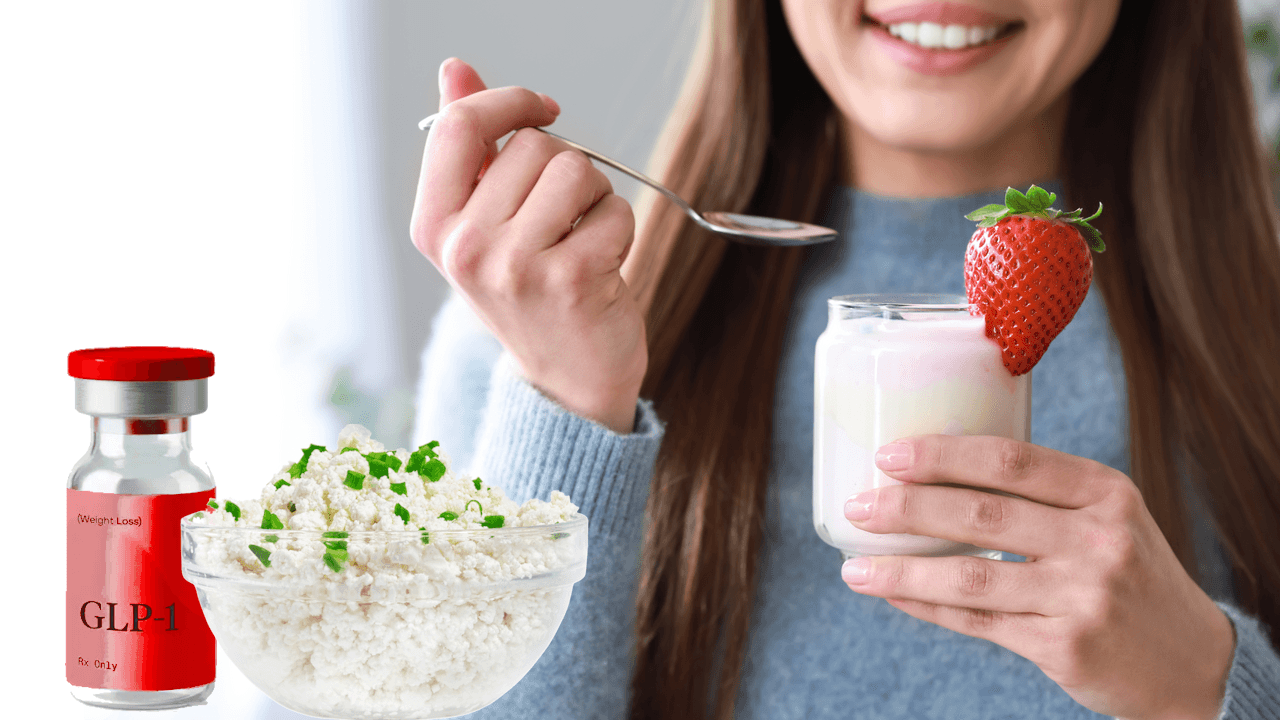
Two of the dairy products that have received a boost in sales are yogurt and cottage cheese. Gurley and Cocco report that a recent study found that grocery spending in households of GLP-1 users went down, except for items such as “yogurt, fresh fruit, nutrition bars, and meat snacks such as jerky.” They also report, “The production of cottage cheese and yogurt, which are favorites of GLP-1-friendly diets because of their high protein content, has soared, especially since the latter half of 2022.”
When it comes to these dairy products, Spencer Nadolsky, an obesity medicine physician, believes, “What's old is new again.”[6] How old are cottage cheese and yogurt? According to media specialist Meredith Holser, “Evidence shows the Mesopotamians made something close to cottage cheese as early as 3,000 B.C, with Egyptians doing the same about a millennium earlier. Even Homer’s Odyssey acknowledges the origin of cheese using rennin, an enzyme found in animal stomachs that coagulates milk.”[7] The same can be said about yogurt. According to Wikipedia, “The origins of yogurt are unknown but it was probably discovered first by Neolithic people in Central Asia and Mesopotamia around 5000 BC, when the first milk-producing animals were domesticated. They most likely found out how to ferment milk by chance and in all likelihood, yogurt was discovered independently in this way in many different places at different times.”
There is no doubt that the GLP-1 craze has been good for the cottage cheese industry. Journalist Niko Gallogly reports, “Until recently, cottage cheese had been dismissed as a soulless diet food. Sales of the product peaked in the 1970s, when the average American ate about five pounds of it per year, according to the U.S. Department of Agriculture. But dairy manufacturers began to refocus their processing capacity on yogurt, which eclipsed cottage cheese sales by the mid-1980s.”[8] Currently, he reports, stores often can’t keep cottage cheese on the shelves because it has become so popular.
GLP-1 users should be aware that some yogurts are better than others for their diets. Jay Hastings, CEO of PlexusDx, reports, “Greek yogurt and Icelandic-style skyr contain nearly double the protein of regular yogurt, which aligns well with GLP-1 therapy goals. Higher protein intake preserves muscle mass during weight loss and extends fullness between meals, reducing overall calorie intake without conscious restriction. Plain, unsweetened varieties eliminate added sugars that may amplify nausea or blood sugar swings when combined with GLP-1 medication effects. Fermented yogurts with live active cultures offer probiotics that support gut health, an important consideration because GLP-1 medications can alter digestion patterns. Avoid flavored yogurts and yogurt drinks with added sugars, corn syrup, or honey unless your clinical team confirms they fit your individual tolerance profile. If dairy causes bloating or discomfort, plant-based yogurt alternatives made from coconut, oat, or soy can provide similar texture and protein without the lactose challenge.”[9]
Concluding Thoughts
There is no doubt that the food industry is feeling the effects of a rising generation of GLP-1 drug users. Gurley and Cocco report, “Big Food is evolving to meet the GLP-1 protein craze, although some nutritionists say that Americans are going overboard.” They note that many products are now infused with protein or tout their protein content. The dairy industry, however, has probably benefited most from changing food habits with the rise in sales of both cottage cheese and yogurt. The National Milk Producers Federation reports, “Dairy consumption overall is its highest since the 1950s.”[10] As children, many of us probably had the same reaction to cottage cheese as did Holser, who notes, “It was always the stupendously slimy snack my mom would try to get me to eat for ‘health reasons,’ when all I wanted was to gnaw on some Fruit Roll-Ups.” Now, many of us just can’t get enough of the stuff. Go figure.
Footnotes
[1] Tamar Haspel, “GLP-1 drugs might do what food policy can’t — change the way we eat,” The Washington Post, 29 January 2026.
[2] Lucas Cuni-Mertz, “GLP-1 users spark product revamps,” Food Business News, 16 July 2026.
[3] Gill Hyslop, “The GLP-1 tsunami isn’t a diet trend – it’s a stress test for the food system,” Food Navigator, 5 February 2026.
[4] Lauren Kaori Gurley and Federica Cocco, “Cottage cheese is in, chips are out — and Ozempic is just one reason,” The Washington Post, 22 June 2026.
[5] Staff, “It’s a GLP-1 World. You Need Dairy to Live in It,” National Milk Producers Federation, 8 June 2026.
[6] Natalie Rahhal, “Chipotle, Chick-fil-A and cottage cheese: The foods helping GLP-1 users hit their protein goals,” Yahoo Life, 6 June 2026.
[7] Meredith Holser, “Why Are People...Eating Cottage Cheese Again?” Brit + Co, 25 July 2023.
[8] Niko Gallogly, “Where Has All the Cottage Cheese Gone?” The New York Times, 20 June 2026.
[9] Jay Hastings, “Navigating Your Diet: Can I Eat Yogurt on Ozempic and Other GLP-1 Medications for Optimal Wellness?” PlexusDx, 5 June 2026.
[10] Staff, “Cottage Cheese and a Boom Built to Last,” National Milk Producers Federation, 6 April 2026.