Stephen DeAngelis
A century-and-a-half ago, a super El Niño created severe weather conditions resulting in a global famine that killed an estimated 50 million people. Freelance writer Darren Orf reports, “While it might be tempting to shrug off this climate event as a fluke, a 2020 study … found that in statistical terms, the strength of the 1877-78 El Niño was not significantly greater than three other super El Niño events in 1982-83, 1997-98, and 2015-16. Now, the world is preparing to enter a new El Niño era further exacerbated by warmer temperatures caused by climate change.”[1] In fact, scientists are warning that the super El Niño currently building could be the most severe event yet. Journalist Fernanda González reports, “The world could face the strongest El Niño since recordkeeping began, increasing the likelihood of extreme weather events and significant, long-term economic impacts globally. A new analysis by Berkeley Earth climate scientist Zeke Hausfather paints a worrying picture of the climate phenomenon developing in the Pacific Ocean. Models have consistently forecast that this year's El Niño — characterized by hotter than normal waters in the eastern tropical Pacific — could be among the strongest on records. Hausfather's analysis using the El Niño forecast based on 14 climate models through July indicates that ‘this year’s El Niño is not only very likely to be the strongest event since reliable records began — it may end up the strongest by a truly mind-blowing margin.’”[2]
It’s Already Begun
Like a steam boiler building pressure, an El Niño event develops over time — and the clock has started. Journalist Ellyn Lapointe reports, “The National Oceanic and Atmospheric Administration (NOAA) officially declared El Niño in June. This is the warm phase of the El Niño-Southern Oscillation (ENSO), a periodic fluctuation in sea surface temperatures and air pressure over the equatorial Pacific Ocean. As El Niño ramps up, the ocean pumps more and more heat into the atmosphere, with peak sea surface temperatures arriving between November and February. Because this peak occurs so late in the year, we see the biggest global temperature impact the year after El Niño forms.”[3] In other words, watch out for severe weather in 2027.
Some areas, however, are already feeling the effects of the developing super El Niño. For example, locations along the U.S. West Coast are experiencing high temperatures and humidity and, as the super El Niño develops, weather forecasters are predicting dangerous surf, stronger storms, and an increased risk of coastal flooding.[4] The West Coast isn’t the only location experiencing changing weather. Journalist Zachary-Taylor Wright reports, “Weather in Texas has been strange this year. Historic flooding in the middle of summer and cold fronts making their way into the Lone Star State at the height of June have left outdoor thermometers yo-yoing and pushed residents to remain weather alert. But as the fall season approaches, with just over a month until the meteorological season changes, peculiar system swings could be the new norm through next year as the ‘Super Niño’ develops. … As this pushes the subtropical jet stream further south over Texas, this could have massive implications on the fall and winter seasons. … This mixture of higher precipitation and lower temperatures can even lead to record snow events in the Lone Star State.”[5]
This year is likely to be the warmest on record and next year is predicted to be even warmer. “The world is looking at ‘an unprecedented combination’ between the strong El Niño and the elevated warmth from climate change, said Daniel Swain, a climate scientist with the University of California Agriculture and Natural Resources. That will influence what El Niño actually means on the ground in the U.S. and across the world, Swain said. … ‘A potentially record-breaking El Niño on top of record-breaking global temperatures to begin with is a pretty big deal,’ he said.”[6]
Effects on the Global Food Supply Chain
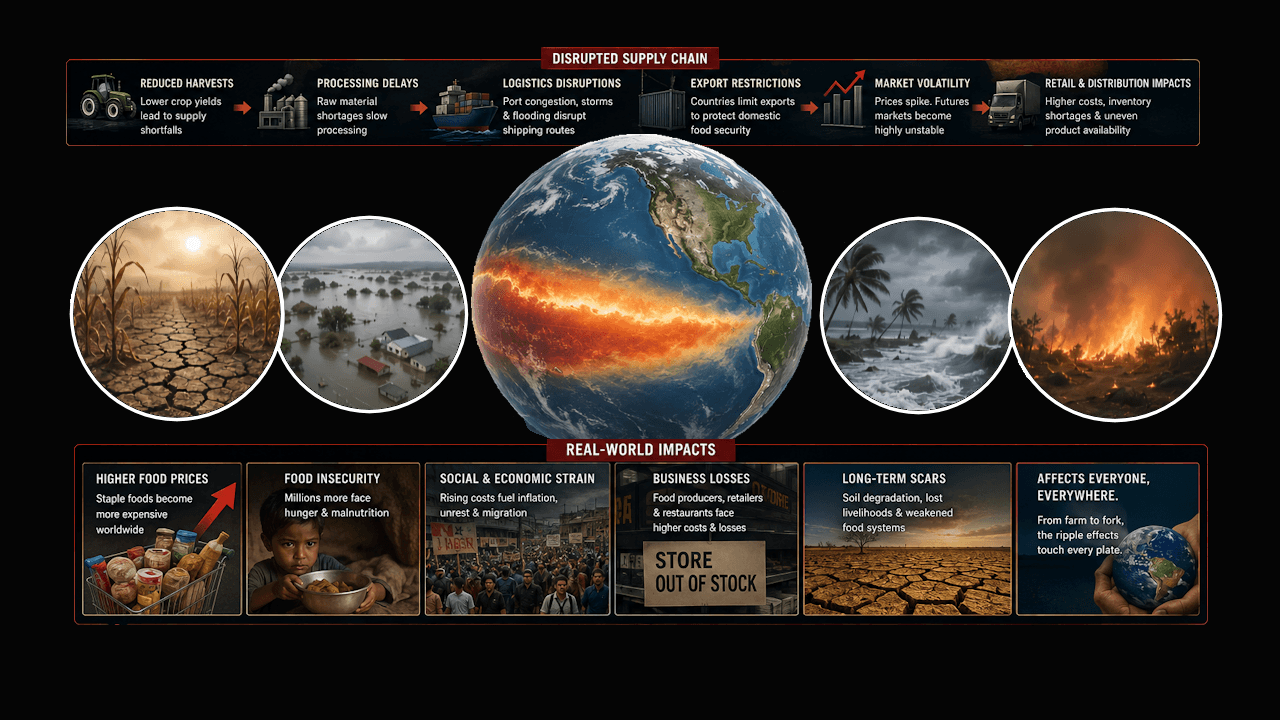
Journalists Dinah Voyles Pulver and Doyle Rice report, “Because of its influence on hydrologic cycles, El Niño can bring catastrophic floods to some regions but severe drought and wildfires to others. It can also disrupt fisheries and food production and bring about trillions of dollars in economic losses.”[7] A look back at the 1982-1983 super El Niño can provide us some idea of what we might expect next year. During that event, reports freelance journalist Tracy J. Wholf, “The trade winds collapsed and reversed, causing weather disasters on nearly every continent. Australia, Africa and Indonesia experienced droughts, dust storms and wildfires, while Peru and portions of South America saw some of the heaviest rainfall in recorded history. That El Niño event was blamed for nearly 2,000 deaths and more than $13 billion in damages.”[8]
It should come as no surprise that the world’s fisheries are adversely affected by a super El Niño’s warming ocean waters. Climate journalist Joseph Winters reports, “We’re not even one month into ‘super’ El Niño, the natural Pacific weather pattern characterized by warmer-than-average sea surface temperatures, and fisheries around the world are already getting scrambled. In Peru, government officials have effectively canceled the fishing season for anchovies, one of the country’s most important exports and a leading source of fish oil and animal feed globally. The Indian government is preparing for a season of smaller, less plentiful Indian mackerel. Meanwhile, in Southern California, recreational and commercial fishers have reported some of the most successful months of tuna fishing they’ve ever seen. The divergent situations show how El Niño can create winners and losers across the fishing industry, decimating some species while making others easier to catch. For fishers, the result is instability, with many forced to consider seasonal diversification. And consumers can expect fluctuations in the price of key fish products.”[9]
Food production ashore will also be impacted. Journalist Sarah Parsons explains, “We know El Niño affects food production beyond just seafood because it can alter global atmospheric circulation, influencing temperatures, precipitation, drought, flooding and storms around the world. Our understanding of food production linked to El Niño and other major climate patterns is still in its infancy. We know ENSO matters, but there’s a lot of uncertainty, and impacts tend to vary considerably around the globe. What we can say is that El Niño has historically shifted food-production risk across regions. Some places benefit, some are harmed, and the global average effect can hide severe local impacts. El Niño-induced droughts can cause food losses in some places — most concerningly, in areas that are rainfed, low-income, import-dependent and already food-insecure. For example, some regions in Southern Africa have generally experienced reduced cereal production during El Niño events due to drier and hotter growing seasons, leading to increased import needs. But the size of the impact depends on local rainfall, heat, crop calendars, starting soil moisture, government response, markets and whether other climate patterns such as the Indian Ocean Dipole (IOD) reinforce or offset the El Niño.”[10]
Food journalist Gill Hyslop observes that the effects of a super El Niño on the food supply chain will be spread over the next couple of years. She explains, “While the weather pattern itself is expected to weaken during the second half of next year, its commercial impact is likely to last much longer as crop losses, transport disruption, and rising raw material costs gradually feed through supply chains.”[11] She adds, “The effects won’t be felt all at once. Fresh produce is expected to react first, followed by grains, such as wheat and rice, within three to six months. Processed foods edible oils, and packaged products are more likely to experience cost inflation six to 12 months later as existing contracts expire and manufacturers begin replacing inventories at higher prices.”
Concluding Thoughts
Economic journalist Richard Partington warns that the economic impacts of a super El Niño could be significant. He explains, “At a time when households around the world are already feeling the pinch from soaring living costs, experts say an extreme El Niño could add further to the pressure. The prospect of a renewed inflation shock is also rattling central banks, adding to concern that interest rates could be kept at elevated levels.”[12] Like Hyslop, he highlights the fact that the impacts of the El Niño will play out over time. He writes, “The full effect will take time because of how the cost of climate impact percolates through global food supplies. As a result, Goldman Sachs said the consequences could take until the second half of 2028 to be ‘fully realized.’ Most of the delay is down to the timing of extreme weather hitting food production, given the differing planting, growing and harvesting cycles for different types of crops. Logistical challenges — including water levels in canals and rivers used for key shipments — will also have an impact.” With global food value chain already under stress as a result of geopolitical tensions, the onset of a super El Niño is not good news. The food industry would be wise to run a significant number of “what if” exercises to help them cope with the unfolding situation.
Footnotes
[1] Darren Orf, “150 Years Ago, a Super El Niño Killed 50 Million People. The Next One Is Right Around the Corner.” Popular Mechanics, 17 June 2026.
[2] Fernanda González, “The 2026 El Niño Is on Track to Be the Strongest on Record,” Wired, 24 July 2026.
[3] Ellyn Lapointe, “This El Niño Is on Track to Become the Strongest on Record by a ‘Mind-Blowing Margin’,” Gizmodo, 27 July 2026.
[4] Jermaine Ong, “The Streamline: As heat scorches region, San Diego prepares for 'super' El Nino,” 10 News San Diego, 27 July 2026.
[5] Zachary-Taylor Wright, “Could historic El Niño bring Texas snow this winter? What to know.” My San Antonio, 27 July 2026.
[6] Dinah Voyles Pulver and Doyle Rice, “‘Mind-blowing’ El Niño stuns scientists. Why are they so concerned?” USA Today, 25 July 2026.
[7] Ibid.
[8] Tracy J. Wholf, “You Asked: What Exactly Is a ‘Super’ El Niño?” State of the Planet, 9 June 2026.
[9] Joseph Winters, “El Niño Is Already Wreaking Havoc on Pacific Fisheries,” Wired, 11 July 2026.
[10] Sarah Parsons, “How Might a ‘Super El Niño’ Affect Food, Forests and Water?” World Resources Institute, 7 July 2026.
[11] Gill Hyslop, “The climate shock that could reshape food costs until 2027,” Food Navigator, 21 July 2026.
[12] Richard Partington, “‘Super’ El Niño could cause global food price shock lasting into 2028, analysts say,” The Guardian, 12 July 2026.