May 21, 2026
Stephen DeAngelis
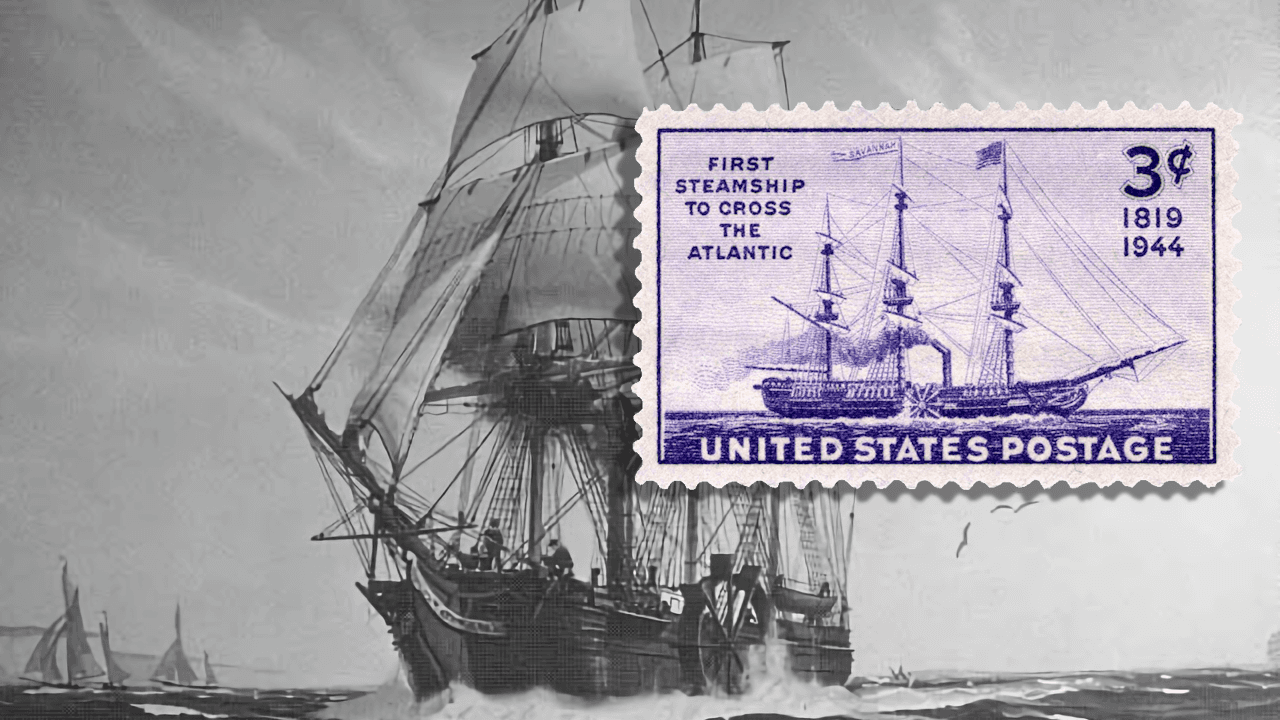
In 1933, Congress declared National Maritime Day should be celebrated annually on 22 May to commemorate the American steamship Savannah’s voyage from the United States to England, marking the first successful crossing of the Atlantic Ocean aided by steam propulsion. The Savannah’s story is worth the telling.
The SS Savannah
In 1818, the Savannah Steam Ship Company, whose principal investor was William Scarbrough, financially backed Captain Moses Rogers in the purchase of a sailing ship being built in the New York shipyard of Fickett & Crockett. In addition to her sails, Rogers fitted the ship — which he named the Savannah — with an auxiliary steam engine and paddlewheels. His intention was to initiate a cross-Atlantic steamship service. In March 1819, after its launch and successful sea trials, the ship sailed from New York City to Savannah, Georgia. On learning that President James Monroe was visiting Charleston, South Carolina, Scarbrough instructed Rogers to sail to Charleston to invite the President to return to the city of Savannah aboard the steamship. Monroe accepted the invitation. During the voyage, Monroe dined on board, and expressed enthusiasm over the prospect of an American vessel inaugurating the world's first transatlantic steamship service.
Unfortunately, the general public was skeptical of steam power and the Savannah was dubbed a “steam coffin.” As a result, and despite the fact that the President of the United States had sailed aboard the vessel, the owners could find no one willing to risk their life or property aboard such a novel vessel. Nevertheless, they were determined to make the Atlantic crossing. Scheduled initially to set sail on 20 May, the Savannah’s departure was delayed for two days after one of her crew returned to the vessel in a highly inebriated state, fell off the gangplank, and drowned. The ship left Savannah Harbor on 22 May bound for Liverpool, England. Wikipedia reports, “Several days later, on May 29, the schooner Contract spied a vessel ‘with volumes of smoke issuing’, and assuming it was a ship on fire, pursued it for several hours but was unable to catch up. Contract's skipper eventually concluded the smoking vessel must be a steamboat crossing for Europe, exciting his admiration as ‘a proud monument of Yankee skill and enterprise’.” On 18 June, the ship was becalmed off Cork after running out of fuel for her engine. After the winds picked up, the ship made its way to Liverpool and arrived on 20 June.
After a 25-day port call in Liverpool, the Savannah set sail for St. Petersburgh, Russia. In early August, it arrived in Helsingør, Denmark, spent five days in port and then headed for Stockholm, Sweden, becoming the first steamship to enter the Baltic Sea. The Swedes were so impressed they offered to purchase the vessel. The Savannah left Stockholm on 5 September headed for Kronstadt, Russia, arriving there on 9 September. It finally reached St. Petersburgh on 13 September.
The Savannah headed for home on 29 September 1819. The ship arrived safely home on 30 November, just over six months from the date of her departure. Wikipedia reports, “In spite of this historic voyage, the great space taken up by her large engine and its fuel at the expense of cargo, and the public's anxiety over embracing her revolutionary steam power, kept Savannah from being a commercial success as a steamship. Originally laid down as a sailing packet, she was, following a severe and unrelated reversal of the financial fortunes of her owners, converted back into a sailing ship shortly after returning from Europe. Savannah was wrecked off Long Island, New York, in 1821. No other American-owned steamship would cross the Atlantic for almost thirty years after Savannah's pioneering voyage.”
The Importance of National Maritime Day
The U.S. Maritime Administration (MARAD) notes, “Maritime Day is a time-honored tradition that recognizes one of our country’s most important industries. Each year, ceremonies and celebrations throughout the country recognize Maritime Day and the people our maritime nation depends on.”[1] The American Maritime Partnership (AMP) observes, “From the earliest days of our nation, shipping has been the key to America’s economic strength and security. Today, the maritime industry is by and large the most economically sound form of domestic transportation, moving almost 1 billion tons of cargo annually at a fraction of the cost of other modes. Critical U.S. industries depend on the efficiencies and economies of domestic maritime transportation to move raw materials and other critical commodities. America’s domestic maritime industry is responsible for almost 650,000 jobs and over $150 billion in annual economic output, according to a recent study conducted by PricewaterhouseCoopers for the Transportation Institute. Labor compensation associated with the domestic fleet exceeds $41 billion annually, with those wages spent in virtually every corner of the United States. ... For every direct job in in American maritime, the industry is responsible for nearly five indirect jobs elsewhere in the U.S. economy.”[2]
From that description, one might think the America’s maritime sector is in great shape. That is not entirely true. During the Trump administration, there has been increased attention to the state of the U.S. shipbuilding and U.S.-flagged vessels. CBS “60 Minutes” correspondents report, “American shipbuilding is in shambles, due to decades of shortsighted policies and neglect. Our submarine building program is sluggish. And our commercial shipbuilding is nearly extinct. China makes roughly 1,000 cargo ships a year. The U.S.? Maybe three. The Trump administration has called this a national security crisis.”[3]
In late April, Congress held a hearing about the shipbuilding crisis. Following the hearing, journalist Mike Schuler reported, “Stephen Carmel, administrator of U.S. Maritime Administration, offered perhaps the hearing’s most striking testimony, arguing the U.S. has misdiagnosed the shipbuilding problem for decades. In a sweeping systems-level argument, Carmel said shipbuilding is not the root of maritime decline but a downstream consequence of weak cargo policy. ‘Cargo demand precedes and enables vessel deployment. Sustained vessel deployment supports shipbuilding,’ Carmel testified, arguing maritime power cannot be rebuilt by subsidizing yards alone without restoring cargo flows to U.S.-linked shipping. The argument echoed a broader administration theme that maritime policy must extend beyond naval procurement to trade, logistics and commercial fleet capacity.”[4]
Although most of the attention is focused on ocean-going maritime trade, as noted above, the U.S. also boasts a healthy domestic maritime trade. The American Bureau of Shipping (ABS) reports, “There are approximately 41,000 vessels making up the domestic trading fleet, the majority of these being tugs and barges. The rest are made up of offshore supply vessels, ferries, dredges, and approximately 100 large ocean-sailing cargo ships.”[5] These vessels sail mostly over 25,000 miles of navigable domestic waters, including rivers, canals, and intracoastal waterways.
Concluding Thoughts
Although America has maintained a strong naval force following the Second World War, prolonged, peaceful freedom of the seas resulted in a complacency that politicians and the public are beginning to regret. They are once again realizing that America is a maritime nation dependent on the maritime industry to bolster the economy and keep the country secure. National Maritime Day is an excellent opportunity to thank maritime professionals and naval personnel as well as supporting efforts aimed at bolstering America’s maritime industry.
Footnotes
[1] Staff, “National Maritime Day,” U.S. Department of Transportation, Maritime Administration, 3 April 2025.
[2] Staff, “The domestic maritime industry is key to America’s economic strength and security.” The American Maritime Partnership.
[3] Lesley Stahl, Shachar Bar-On, Jinsol Jung, “With South Korea and China building ships faster and cheaper than U.S., Trump makes shipbuilding a priority,” CBS News 60 Minutes, 22 March 2036.
[4] Mike Schuler, “Congress Confronts U.S. Shipbuilding Crisis as Maritime Buildout Meets Reality Check,” gCaptain, 22 April 2026.
[5] Staff, “The U.S. Commercial Maritime Industry,” American Bureau of Shipping, January 2025.