Mar 24, 2026
Stephen DeAngelis
Americans are going to celebrate many aspects of American life during this semiquincentennial anniversary of the publishing of the Declaration of Independence. One area that deserves celebrating is America’s agricultural history. Two hundred and fifty years ago, most industry and commerce were concentrated in New England’s due to the area’s many harbors and mills. The rest of America’s economy was primarily agricultural. Over the next century, the country grew westward and agriculture became an even more significant part of America’s economy.
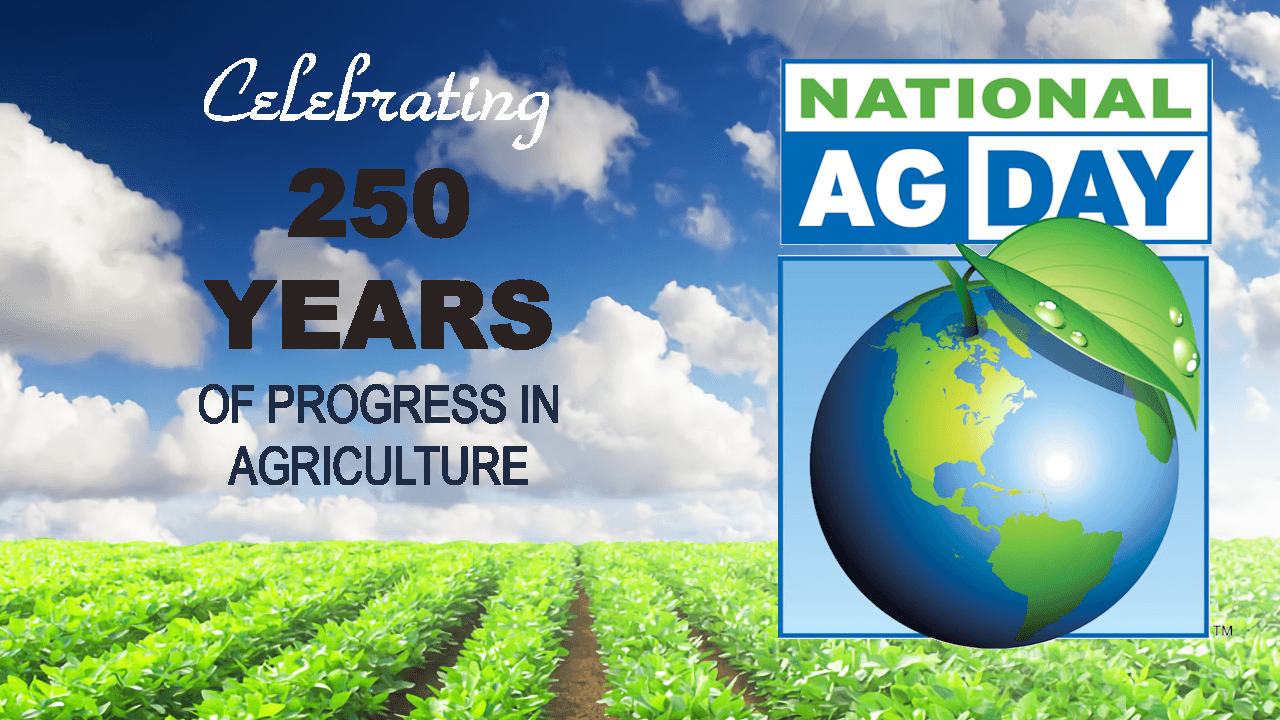
Today is National Agriculture Day (or National Ag Day) and the theme for this year is “Together We Grow: Celebrating 250 Years of Progress in Agriculture.” The celebration is sponsored annually by the Agricultural Council of America (ACA). This year’s celebration focuses on “the dedication of America’s farmers and the bounty of American agriculture.”[1] Chuck Zimmerman, President of ZimmComm, writes, “This year’s theme emphasizes the collaborative efforts of farmers, ranchers, and all stakeholders in the agricultural sector who work tirelessly to provide safe, abundant, and affordable products and also recognizes 250 years of progress.”[2]
250 Years of Progress in Agriculture
Many people longing to return to the good old days probably don’t know what the good old days were like. Two-hundred-and-fifty years ago agriculture was primarily manual and subsistence-based, with roughly 95% of the U.S. population working in farming. Families used hand tools like hoes, scythes, and plows, relying on human and animal labor to produce crops for personal consumption and limited local trade. It was hard, tedious work. Farming has never been easy, but today automation plays a much larger role in food production and other agricultural activities.
Supply chain journalist Nick Bowman reports, “Traditionally, agriculture conjures images of workers tilling fields and picking crops. But as climate change has led to longer dry seasons, strained water supplies, and reduced yields, farmers have turned to a wide range of modern technologies that are anything but traditional.”[3] He observes that there are now machines that can test soil, harvest crops, leverage precision farming techniques, monitor the weather, and help with workforce assignments. He concludes, “By reducing the need for repetitive manual work and allowing farmers to focus their labor where it’s most valuable, these tools can not only help lower costs, but also improve consistency and quality across harvests. For farmers, the path forward isn’t about choosing between tradition and technology; it’s about using the best of both to stay resilient in the face of growing global climate risks. From water and soil to labor and yields, every smart tool that eases pressure today helps ensure there’s a harvest tomorrow.”
Thanks to technology, the percentage of the U.S. population working in agriculture today is surprisingly small. The staff at the Tennessee Farm Bureau observes, “Agriculture is no doubt our most important industry. However, too few people truly understand that, so we celebrate National Ag Day because it brings to light the less than 2% of the population who are working incredibly hard daily to provide all of us with food, fiber and fuel.”[4] Agriculture, however, is also a job creator. In addition to those working directly on farms, there are a host of supporting activities that move products from farm to table. Those activities include related industries like food processing, manufacturing, and distribution. When they are included, the agricultural and food sector supports approximately 10.4% of total U.S. employment.[5]
Looking to the Future
Although America’s semiquincentennial celebration is a great time to reflect on the past, it’s an even better time to look to the future. Joby Young, Executive Vice President at the American Farm Bureau Federation, explains, “Agriculture has long been defined by innovation, as farmers, especially in recent decades, have leveraged technology to improve yields, adapt to challenges and ensure their farms remain strong and sustainable for seasons to come. Innovation in areas such as data, crop protection tools, and biotech, have all led to better nutrition, improved environmental outcomes and greater food availability and affordability for Americans. But today, as the headwinds in agriculture continue to grow and technology advances, the conversations around innovation matter more than ever.”[6]
Like in most economic sectors, artificial intelligence (AI) is poised to play a significant role in future operations. Young observes, “Today, we’re seeing incredible advancements happening in the world of agricultural innovation. From new equipment that utilizes AI algorithms to platforms with the capability to analyze crop health in real-time, farmers are able to navigate numerous tasks and access insight that previously would have taken days or weeks to complete.” He adds, “We also need to make sure as more technology becomes available, we safeguard the interests of our farmers and work in partnership across the entire supply chain.” We also need to ensure that the technologies that help farmers produce more and better crops are affordable.
Concluding Thoughts
The staff at National Today observes, “Everything we eat, use, or wear every day is provided by agriculture. Most people don’t understand the contribution of agriculture to our lives. … So today we are celebrating agriculture and thanking all the people who work hard to feed the world, look after crops and livestock, and contribute to agricultural production.”[7] In addition to thanking people associated with agriculture, Young believes we should be actively engaged in ensuring that food value chain is resilient and affordable. He concludes, “Innovation touches every part of our food system. Whether you’re a farmer adopting new technology, an innovator with a groundbreaking idea, or a consumer enjoying a variety of healthy, safe, and affordable choices in the grocery store, innovation plays a role. We need to make sure there is partnership on every level so that farmers have access to new ideas and that our researchers and entrepreneurs know the needs of our farms and rural communities. By establishing a pipeline of innovation across the supply chain, we will have a food supply that remains strong and resilient for whatever tomorrow brings.”
Footnotes
[1] Staff, “Ag Day Social Media Toolkit 2026,” Agricultural Council of America.
[2] Chuck Zimmerman, “2026 National Ag Day,” AgWired, 26 January 2026.
[3] Nick Bowman, “AI and Robotics Take Root in Modern Agriculture,” SupplyChainBrain, 25 September 2025.
[4] Staff, “National Ag Day,” Tennessee Farm Bureau.
[5] Kathleen Kassel, “Agriculture and its related industries provide 10.4 percent of U.S. employment,” USDA Economic Research Service, 3 November 2023.
[6] Joby Young, “Ag Innovation: The Key to Tomorrow,” 17 April 2025.
[7] Staff, “National Ag Day,” National Today.