Stephen DeAngelis
Several years ago, Debbie Ellison, Croud CEO for Europe, the Middle East and Africa, wrote, “The purchase journey as we know it is fast disappearing, thanks to the rise and rise of ecommerce.”[1] The purchase journey to which she refers involves the traditional sales funnel. Frankly, I’m surprised she didn’t just assert that the traditional purchase journey had totally disappeared. Years before she made her assertion, McKinsey & Company analysts, David Court, Dave Elzinga, Susan Mulder, and Ole Jørgen Vetvik, wrote, "For years, touch points have been understood through the metaphor of a ‘funnel’ — consumers start with a number of potential brands in mind (the wide end of the funnel), marketing is then directed at them as they methodically reduce that number and move through the funnel, and at the end they emerge with the one brand they chose to purchase.”[2]
They went on to note, “Today, the funnel concept fails to capture all the touch points and key buying factors resulting from the explosion of product choices and digital channels, coupled with the emergence of an increasingly discerning, well-informed consumer.” Since the beginning of ecommerce age, analysts have tried depicting the consumer's digital path to purchase in a variety of ways — funnels, loops within loops, circles, and so forth. Despite numerous assertions that the sales funnel is dead, discussions about it persist.
The Fading Funnel
Marketing expert Tanya Thorson writes, “For decades, marketing leaders guided buyers through a neat sequence from awareness to purchase. Today, that linear funnel model is breaking down. Buyers now chart their own course — jumping between channels, self-educating via digital content and often engaging sales late, if at all.”[3] Most customer journeys begin with a touchpoint. In the past, there were fewer initial touchpoints — mostly newspapers, magazines, radio, television, and billboards. Since the beginning of the digital age, those touchpoints have exploded and consumer journeys have become much more difficult to depict.
Analysts from the Boston Consulting Group (BCG) explain, “Marketers have long understood the complexity of these journeys. But given limited internal resources and the vast number of potential touchpoints, they have traditionally relied on simplified frameworks to guide their efforts. For years, this has meant force-fitting the complex array of touchpoints into a linear, funnel model. (See image below) While this model can be useful for guiding strategy, budget allocation, and communication, it risks missing opportunities because of misallocated resources or wrong messaging. Instead, marketers need a more flexible framework that better aligns with consumers' actual journeys.”[4]
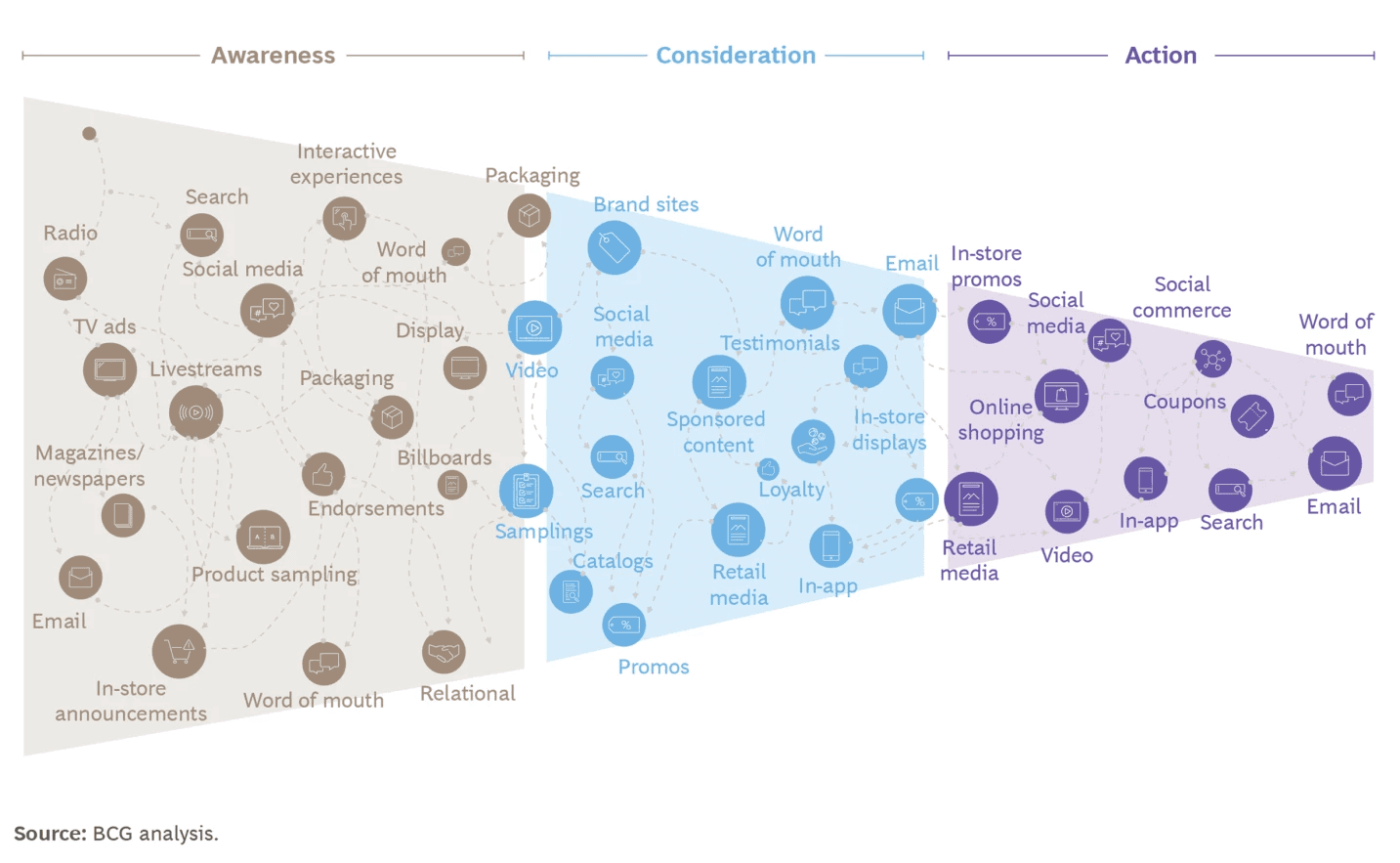
Thorson concludes, “This fragmented, self-directed buyer journey has made traditional funnel-based campaigns increasingly ineffective. … The funnel remains a helpful lens, but only as part of a larger system. Today’s CMO needs a broader view — one that accounts for nonlinear journeys, rapid shifts in customer intent and the accelerating impact of embedded AI.”
Touchpoints and AI Agents
Like Thorson, business coach and author David Finkel believes there is still a place for funnel analogy. He explains, “When it comes to marketing funnels, there are a lot of things to consider. And depending on your product or service, the sales funnel can be rather lengthy — which means that you need to put a lot of time and effort into crafting a sales funnel that keeps your customer engaged, educated, and ultimately ready to convert.”[5] However, in today’s complex environment, it makes more sense to talk about marketing touchpoints rather than funnels. As noted earlier, the number of touchpoints is expanding.
BCG analysts explain the importance of touchpoints. They write, “As marketers consider new planning models, they must also reevaluate the outcomes that they seek to optimize — ensuring that they select touchpoints that drive both reach and influence. More than just visibility, influence is determined by three factors: the level of attention paid by a consumer at any given moment; the relevance of the marketing content to the consumer’s needs; and the consumer’s degree of trust in the touchpoint or platform.” Over half-a-dozen years ago, Christi Olson, Senior Director of Digital Marketing at Azul, insisted there are now so many touchpoints that funnel analogy should be discarded for a flywheel analogy. She explained, “The concept of the flywheel in this context is simple: It's essentially a virtuous cycle, wherein the more customer touchpoints that you create, the more data you acquire, and more data leads to greater personalization and ROI for more productive and plentiful customer touchpoints.”[6]
Because there are so many touchpoints today, Rachel Thornton, CMO of Adobe Enterprise, insists that companies need to consider how artificial intelligence agents are affecting their marketing efforts. She explains, “If you go back a couple of years, you probably would have gone to Google when you would search for something, and that's still valid, but increasingly, people are going to places like ChatGPT or Perplexity.”[7] She says that marketers need to see AI agents as a new consumer audience. Journalist Sabrina Ortiz reports, “A whole new area of specialty has emerged to address this concept, encompassing two related disciplines: generative engine optimization (GEO) and answer engine optimization (AEO). Just as search engine optimization (SEO) focuses on techniques to rank highly in traditional search results and drive website traffic, AEO focuses on structuring content so that AI assistants and agents can readily pull from it, while GEO focuses on optimizing content so that it surfaces naturally within generative answers.”[8]
Concluding Thoughts
Olson noted that the original funnel imagery was created in 1898. Its persistence has been remarkable. Olson, like many others, believes it’s time to retire the model. She explained, “No doubt, future advertising will be completely different from what we know today. Marketers will use AI technologies like digital assistants, intelligent agents, and cognitive services like visual search and natural language processing to engage customers. It will be more natural, more customer-centric and friction-free. And it breaks with the traditional notion that marketers can reach their customers only in linear stages. The funnel — a cornerstone of sales and marketing teams for over 100 years — is quickly becoming obsolete.” Her remarks were prescient. There have been many advances in marketing since she first penned those lines. For example, Enterra Solutions© marketing solution, which is built on the Enterra System of Intelligence©, delivers specialized applications designed to transform the entire marketing function, automating decision-making and delivery while driving measurable revenue growth and operational efficiency.
According to Thornton, “AI can help marketers with their orchestration needs, ensuring campaigns work well across different channels, with agents acting as a supporting cast to help bring those customer journeys to life.” After 128 years, it may be time to retire the funnel analogy.
Footnotes
[1] Debbie Ellison, “Don't waste your tears on the death of the purchase journey,” Campaign, 25 February 2021.
[2] David Court, Dave Elzinga, Susan Mulder, and Ole Jørgen Vetvik, “The consumer decision journey,” McKinsey & Company, 1 June 2009.
[3] Tanya Thorson, “Why today’s buyer journey no longer fits the funnel,” MarTech, 8 December 2025.
[4] Ray Yu, Derek Rodenhausen, Yotam Ariav, Trevor Sponseller, and Clémentine Remy, “It’s Time for Marketers to Move Beyond the Linear Funnel,” Boston Consulting Group, 17 January 2025.
[5] David Finkel, “5 Secrets to Creating a Marketing Funnel That Converts,” Inc., 12 April 2022.
[6] Christi Olson, “Goodbye Funnel, Hello Flywheel: How to Build the New Customer Experience (CX),” MarketingProfs, 4 December 2019.
[7] Sabrina Ortiz, “AI shifts the funnel, not the fundamentals,” The Deep View, 8 May 2026.
[8] Ibid.